

























From family farms to luxury hotel, Malaysia’s celebrated King of Fruits is transforming food travel and changing how the world sees one of its most polarizing foods.
A neighbour reported the smell of a gas leak.
Ann Leong’s office management team searched the entire block, checking walls, pipes and offices with a gas meter. No leak was found.
The culprit was a pile of ripe durian in Leong’s office. Their famously pungent aroma had drifted through the walls into the neighbouring office.
She laughed about it now. For us, “it was just durian,” she said.
It’s powerful, often divisive scent comes from a complex cocktail of more than 50 volatile organic compounds. Across Southeast Asia, that unmistakable scent signals the arrival of the “King of Fruits”.
Durian inspires devotion and debate while drawing people together around the same table. Nowhere will visitors experience this more than in Malaysia.
To understand why, it helps to step away from the cities and visit a durian farm in Sarawak, Malaysia Borneo.
In Ted Chin Jong’s farm, towering durian trees stand among banana and other fruit crops. It wasn’t fruiting season when we visited.
Jong, an agriculturist and durian expert, has spent decades growing fruit and building his farm. His formal training in agriculture in Canada, combined with years of hands-on farm experience, has given him a deep understanding of durian cultivation.
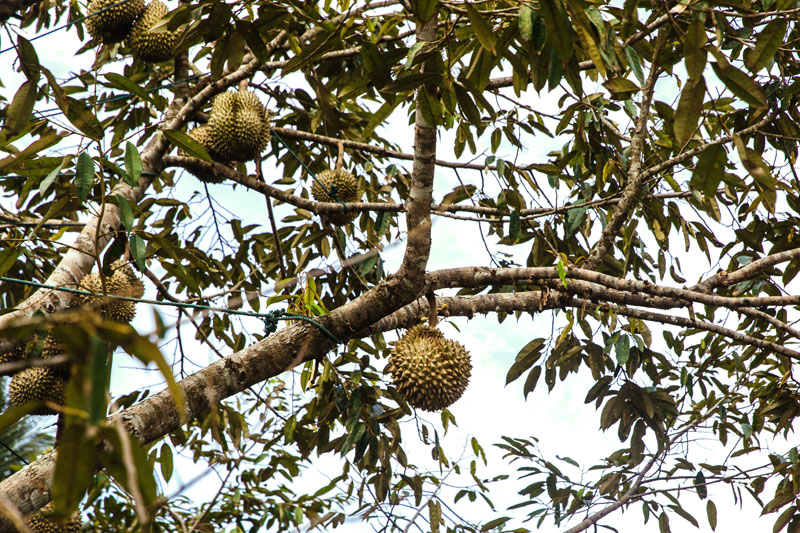
From Farm to Harvest: Durian Growing, Varieties and Flavour Profiles
He noted that durian trees demand more care than many fruit crops. The trees need year-round attention to stay healthy and productive. They require regular seasonal fertilizing and careful management through changing weather conditions, from drought to heavy rains.
Jong grows more than 20 cultivars alongside wild durians, though our conversation often returns to two consumer favourites.
Musang King is prized for its bittersweet richness. Black Thorn for its velvety sweetness.
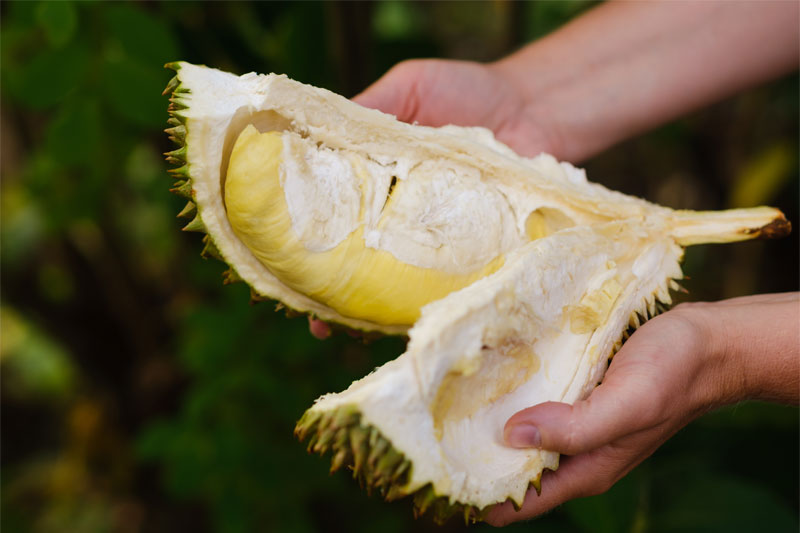
Cracking open the spiky shell reveals pale golden flesh arranged in soft segments. The texture is custard-like, somewhere between crème brûlée and cheesecake.
The flavour is complex—sweetness giving way to bitterness, then notes of caramel, roasted nuts and coffee, with occasional hints of blue cheese.
Devotees cherished the Red Prawn cultivar for its intense sweetness, melting texture, with faint berry and wine-like notes. Its flesh ranges from deep orange to salmon-pink.
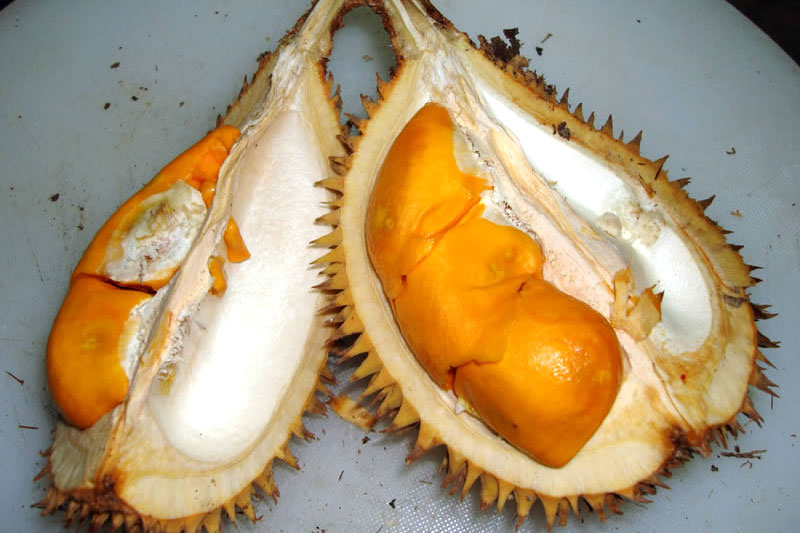
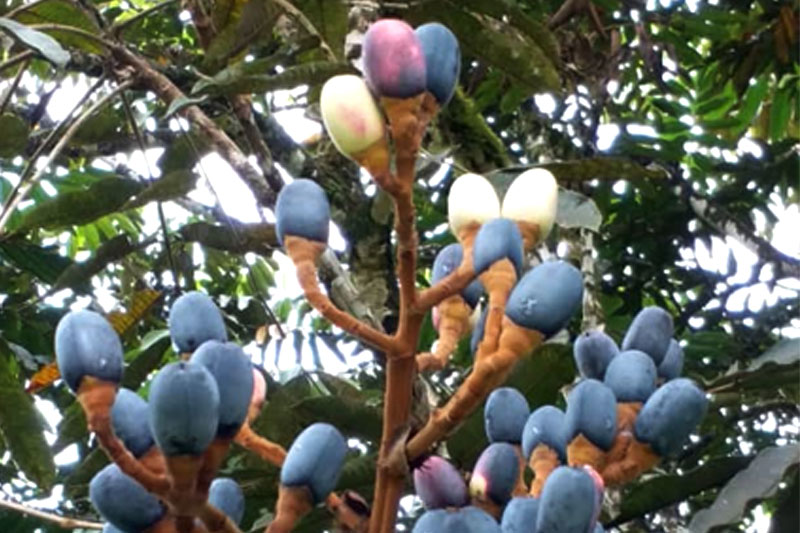
Wild durians still thrive in the Borneo rainforests. Among the most distinctive are Durio graveolens and Durio dulcis, valued for their vivid orange and red flesh.
“Some wild species bear fruit directly from their trunks,” Jong said. An unusual trait that adds to the fruit’s mystique.
“Like fashion, people are always looking for something different. New cultivars are constantly being developed to cater to changing tastes.”
“You can’t rush a good durian.”
“Malaysian Durians are harvested only after they ripen naturally and fall from the tree.”
Workers collect each fallen fruit quickly to preserve peak ripeness and quality – the standard that characterizes Malaysian durian.
That sense of patience shapes how the fruit is grown and harvested, but complicates export for many growers. Yet aficionados say, it produces a richer aroma and a more layered flavour.
Jong believed that extra time on the tree changes the fruit itself, shaping its character. By contrast, growers in Thailand often harvest durians earlier to extend shelf life, resulting in firmer, milder fruit.
A Global Appetite for Malaysian Durians
This difference in harvesting methods has helped define Malaysia’s place in the global market. Once a regional delicacy, premium durian is now in demand globally.
Ahmad Shazril bin Suhaimi, Malaysia Consul General in Vancouver wrote that Malaysian durians are exported to “over 40 countries worldwide.”
“Europe has seen the most dramatic spike in percentage growth,” he noted, adding that shipments to the region have risen by more than 100% in recent years.
Suhaimi stated that “Demand in North America (US and Canada) has risen steadily” as well. He also pointed out that China remains the largest market, accounting for “60% of Malaysia’s total international durian exports.”
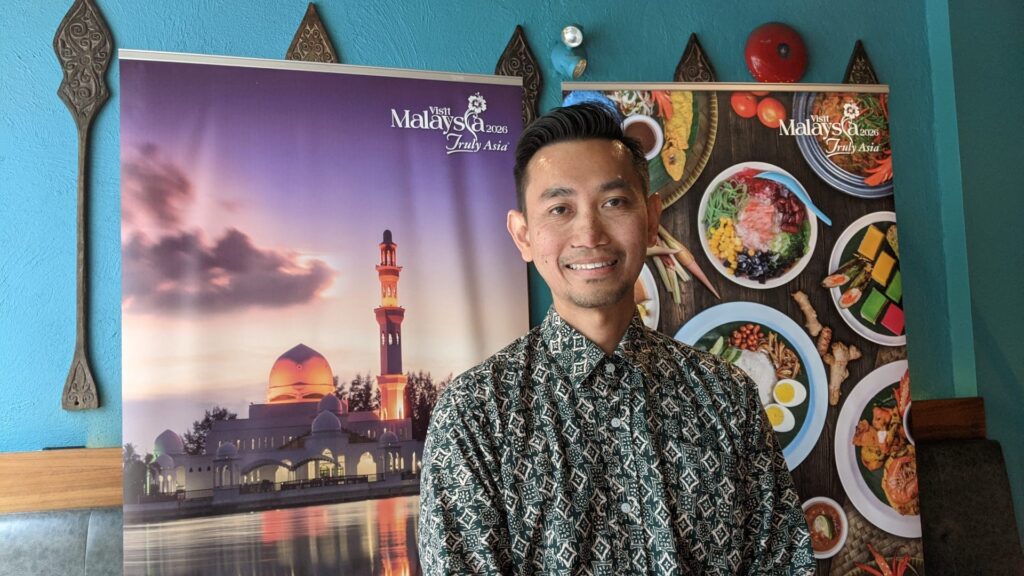
The industry’s profitability has driven larger plantations to embrace precision agriculture to maximize yield and boost efficiency.
Jong noted that durian prices fluctuate with harvest conditions, rising in lean years and falling in abundant ones.
The Travel and Communal Experience
After more than four decades in farming, Jong still sees durian season as something that extends beyond agriculture. He added that people, including visitors from China, Taiwan and South Korea, travel long distances just to eat fresh durian.
During durian season, families and friends gather at market and roadside stalls to crack open and enjoy fresh durians on the spot. This communal experience celebrates Malaysian culture.
Across Penang, Pahang and Johor, family farms increasingly welcome visitors for guided tours and tastings, where they learn to distinguish different cultivars.
Durian-Themed Destinations
Durian’s growing appeal is also reaching beyond the farm. The Kuala Lumpur Durian Experience Centre (KLDEX) is Asia’s first and largest integrated durian destination. The durian stores located in the Bukit Bintang district, Kuala Lumpur offer comfort and convenience for enthusiast.
Former Hong Kong actress Amy Yip, a fervent advocate of the fruit, is developing the world’s first five-star hotel devoted to durian.
The boutique property, scheduled to open in Penang in 2027, will combine farm visits with cultural exhibitions and menus featuring everything from desserts to hot pot and even durian coffee. The setting feels fitting.
Related: The Exotic Fruit with Secret Flavours and Tales of Resilience
Penang – The Food Paradise
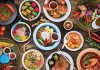
For decades, travellers have come to Penang in search of food. As dusk sets in, charcoal smoke drifts above hawker stalls. Lines form for bowls of laksa while woks clang over roaring flames, filled with savoury char kway teow.
Suhaimi, who has lived in many countries, said, “Nasi lemak is my favourite” among Malaysian dishes. The combination of coconut rice, sambal, and anchovies gives the dish its unique flavour.
Malaysia has earned a place among notable culinary destinations in Asia for its diverse flavours. More recently, some visitors have begun arriving to the country for another reason: to follow the trail of the King of Fruits.
At an event, Leong asked her guests, “How many of you like durian?”
The reactions split immediately – delight, hesitation, curiosity. Everyone, it seems, has an opinion. The mention of the fruit alone is enough to divide opinion, yet also draws people into conversation.
Leong, a destination specialist, smiled; she now knows exactly which fruit will become the talking point. The gas leak has long been forgotten. The conversations it sparked remain.
Published: July 07, 2026 | Updated: July 09, 2026